Ploiești is a city with a distinctive visual identity: historic boulevards, interwar buildings, museums unique in Romania, large parks and places that hold the cultural memory of Prahova. It is a city that can be discovered on foot, with frequent stops for architecture, history, art and nature.
Urban routes
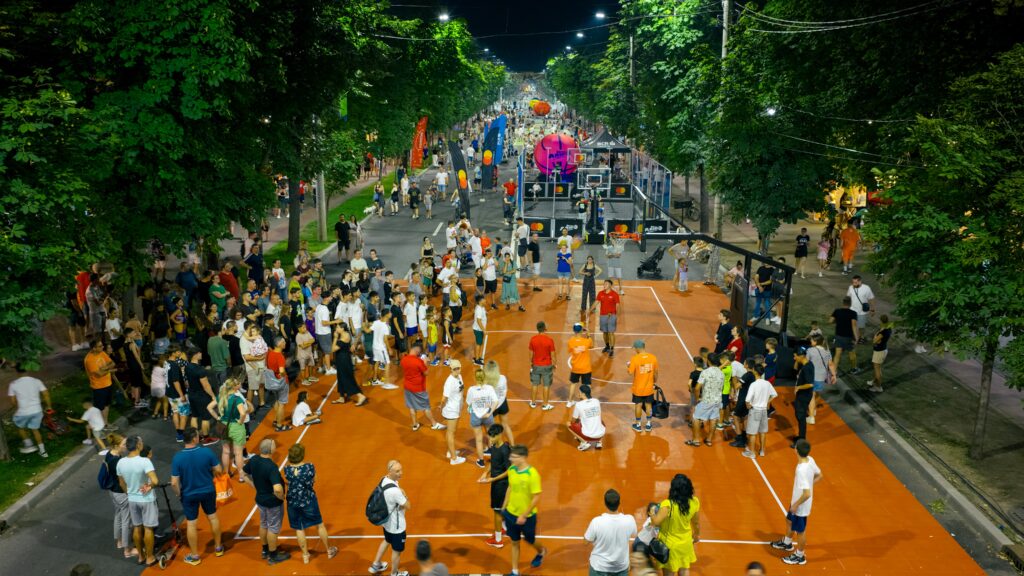
The city’s emblematic axis, an interwar promenade unique in Romania. It links Piața Victoriei to Piața 1 Decembrie 1918, is lined with historic villas and shaded by dozens of old chestnut trees. It is the favourite spot for strolls, urban photography and cultural events.
Flagship event: In summer, the boulevard becomes the stage for the “Republica de sub Castani” (The Republic Under the Chestnuts) programme, a community festival spread over 21 weekends with music, sport, film, gastronomy and activities for all ages.
Historic centre & Palace of Culture
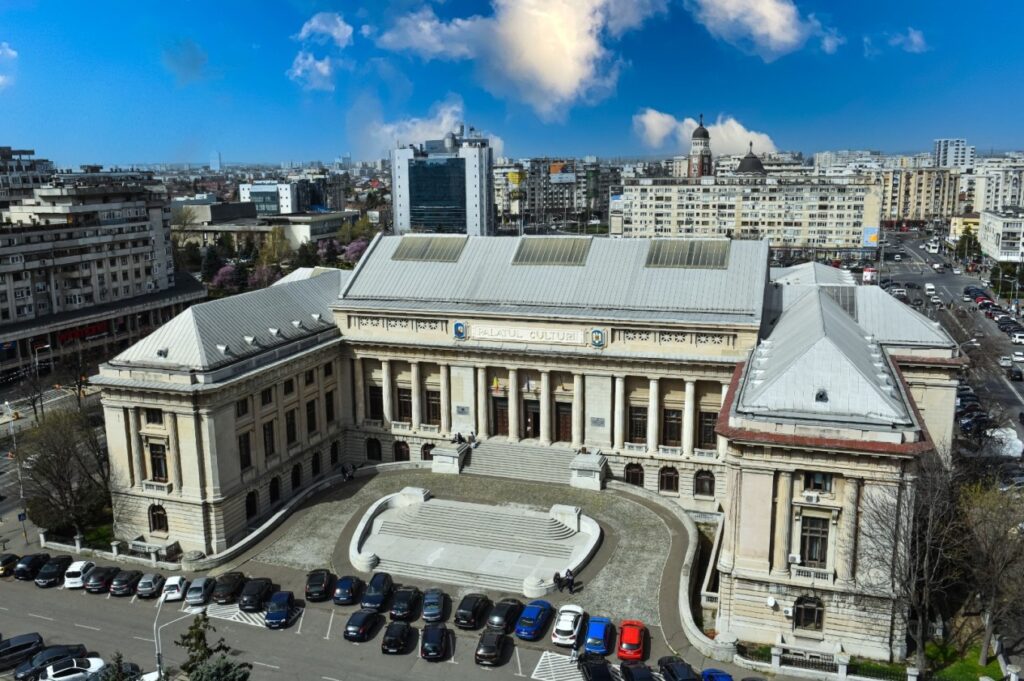
Palace of Culture
The Palace of Culture is one of the major architectural landmarks of Ploiești, a monumental building erected in the 1920s–1930s, during the great urban projects of the interwar period.
The building blends late Neo-Romanian elements with modernist influences, visible in its volumetry, the rhythm of the windows and the way the public spaces are designed. The facades feature wide arcades, pilasters and decorative details that evoke Romanian architectural tradition reinterpreted in the spirit of the 20th century.
Historical highlights:
designed to host the city’s main cultural and administrative institutions
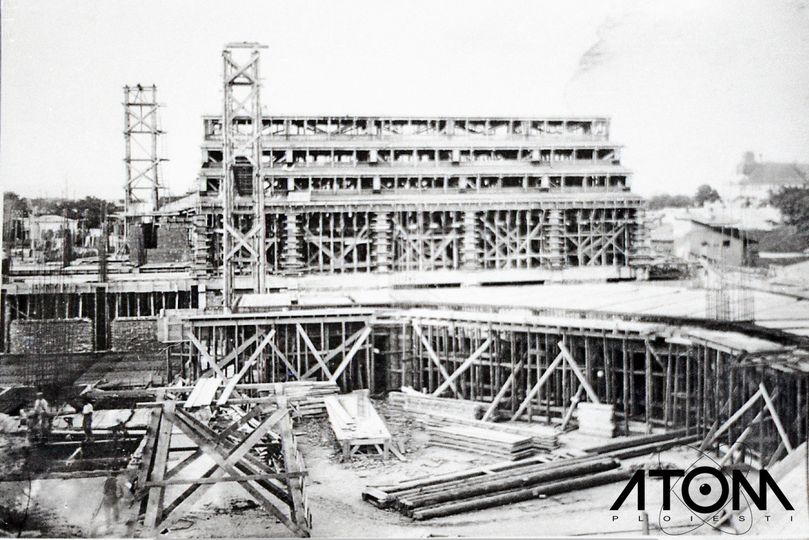
works began in the interwar period and unfolded in several stages
damaged by the 1977 earthquake, the building was consolidated and reorganised in the following decades
remains a recognised urban landmark, thanks to its monumentality and central location
The interior atrium, the wide staircases, the skylights and the stone and wood finishes shape the building’s public spaces and give the Palace its solemn presence.
Today the Palace of Culture acts as a true cultural centre of the municipality, hosting separate institutions. In this section, however, we focus on its architectural value and its role in the city’s identity.
The Halele Centrale (Central Market Halls)
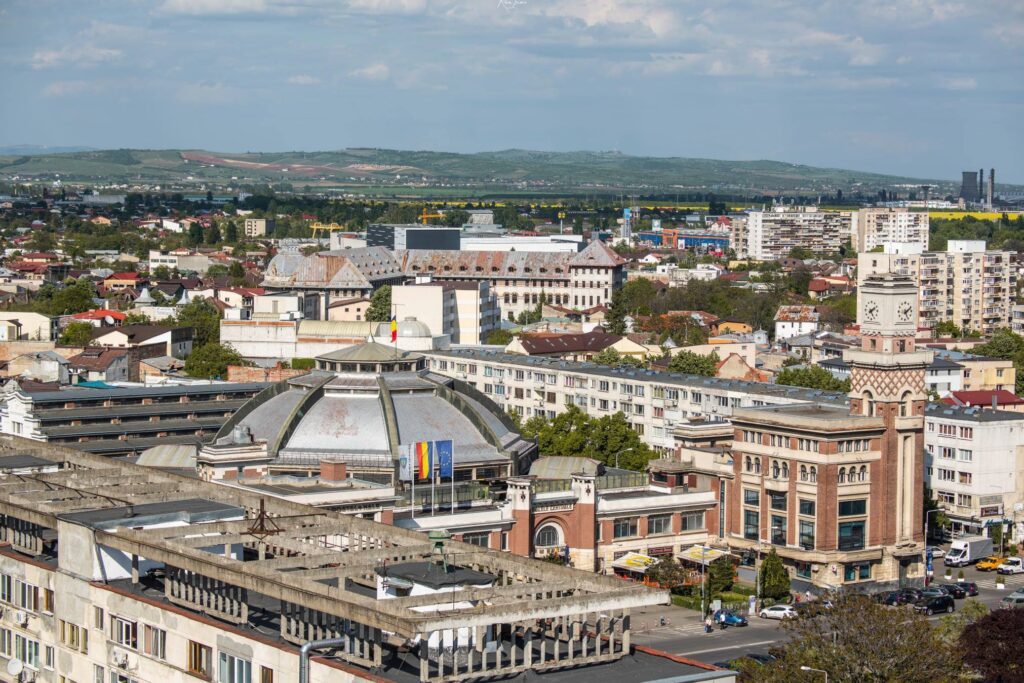
The Halele Centrale (Central Market Halls) are one of the most important works of architect Toma T. Socolescu, built between 1925 and 1935 and considered today a remarkable example of Romanian functionalist architecture.
The project blends modernist aesthetics with technical solutions advanced for the period, reflected in:
the wide steel structure
the efficient natural ventilation system
basements organised for storage, supply and movement
rhythmic skylights and windows that ensure natural light
circulation flows designed for a modern, hygienic market
The facades are treated in a geometric style, with balanced proportions and accents inspired by 1930s modernism and Art Deco.
Historical highlights:
conceived as a “model market” for Romanian cities
part of the interwar vision for modernising the centre of Ploiești
opened in 1935 and used continuously to this day
regarded as one of Socolescu’s finest achievements
The Halls remain not just an emblematic building, but also a hub of urban life in Ploiești. They are among the few historic markets in Romania that have kept their original layout and function, offering today the same urban experience for which they were created.
Museums & memorial houses
National Museum of Oil
Strada Dr. Dumitru Bagdazar nr. 8
The only museum in Romania entirely dedicated to the oil industry. Housed in an eclectic French-style building from the 1880s, the exhibition presents equipment, rare documents, refining models, technical instruments and the history of Romanian oil, an industry that defined the identity of Ploiești.
“Ion Ionescu-Quintus” Prahova County Museum of Art
Bulevardul Independenței nr. 1
Hosted in a historic villa (1885–1894), the museum offers collections of Romanian painting, graphics, sculpture and decorative art. Bringing together works from the 19th and 20th centuries, the institution is a benchmark for visual arts in Prahova.
“Nicolae Simache” Clock Museum
Strada Nicolae Simache nr. 1
Unique in Romania. It is housed in a Neo-Gothic building, the former residence of the conservative prefect Luca Elefterescu. The museum holds an impressive collection of clock mechanisms, pendulum clocks, collector’s clocks, rare items and astronomical instruments.
Prahova County Museum of History and Archaeology
Strada Toma Caragiu nr. 10
A Neoclassical building designed by Alexandru Orăscu (1864), the former seat of the “Sfinții Petru și Pavel” High School. The exhibitions present the history of Prahova from prehistory to the modern era, with archaeological items, documents and local artefacts.
“Prahova” County Museum of Natural Sciences
Palace of Culture – Piața Eroilor no. 1A Includes:
The Museum of Man – an interactive exhibition about biology, the human body, the senses and evolution
The Ploiești Aquarium – freshwater and marine fish collections
An excellent spot for families and educational activities.
“Ion Luca Caragiale” Memorial Museum
Strada Kutuzov nr. 1
Hosted in the Dobrescu House (18th–19th centuries), the museum presents the life of the great playwright and his school years in Ploiești. It features documents, photographs, period furniture and accounts of the Caragiale family.
“Paul Constantinescu” Memorial Museum
Strada Nicolae Bălcescu nr. 15
A classical-style house from 1885–1890, turned into a museum in 1993. It presents documents, scores, personal items and instruments of composer Paul Constantinescu. The courtyard is home to a rare sequoia tree.
“Nichita Stănescu” Memorial Museum
Strada Nichita Stănescu nr. 1
The poet’s parental home, built by his grandfather, Hristea Stănescu. The museum preserves the atmosphere of a peasant plain house and displays manuscripts, letters, personal items and photographs of the poet.
“Constantin and Ion Stere” Memorial Museum
Location: “Constantin Stere” Memorial Park – Bucov
Located just outside Ploiești, the museum is dedicated to the politician Constantin Stere and his son, the lawyer Ion Stere. It presents documents related to the family’s intellectual, legal and political work. (Although it is in Bucov, it is part of the cultural circuit for visitors to Ploiești. If you prefer, we can list it separately under “near Ploiești”.)
Hagi Prodan House – Casa de Târgoveț (Townsman’s House) Museum
Strada Democrației nr. 2
One of the oldest buildings in the city (1785). It belonged to Hagi Prodan, a leading figure of the fair-town. Restored by Toma T. Socolescu after the First World War, the house became Ploiești’s first museum (1927). It presents the life and interior of a Prahova townsman family.
The Racecourse
Ploiești Racecourse is the only working trotting racecourse in Romania and one of the city’s most important sports landmarks. Located along Bulevardul București, near the Petroleum-Gas University, the racecourse forms together with the latter one of the city’s “Gateways”, as defined in the urban development strategy.
Historical highlights
The history of the modern racecourse begins in 1961, when, after the demolition of the Bucharest racecourse (1960), horses and drivers were moved to Ploiești. According to tradition, in March 1961 driver Mircea Ștefănescu led around 200 horses, in column, along the Bucharest–Ploiești route, covering the distance in 9 hours.
Shortly afterwards, on the first Sunday of April 1961, the first Trotting Derby in Ploiești took place, won by Mircea Ștefănescu himself with the stallion Florinel.
Thus, Ploiești became the centre of Romania’s trotting tradition, taking over directly from the Bucharest racecourse.
Modernisation
Between 2014–2016, the racecourse went through a major modernisation and extension project, financed from European funds (≈€15 million). The works covered:
rebuilding the trotting track to European standards
building modern stands
technical spaces, changing rooms, offices, a stewards’ room
reconfigured stables and training areas
electronic timing and photo-finish system
access areas for sulkies, logistics transport and the public
The first official meeting at the new racecourse took place on 15 April 2017.
Statues
Hunters’ Monument
Location: Gara de Sud (South Station) area, Bulevardul Independenței (towards the southern end).
The Hunters’ Monument is one of the most important historical landmarks in Ploiești, a tribute to the Prahova soldiers who fought in the War of Independence (1877–1878). Created at the beginning of the 20th century, the monument depicts the mountain hunters in a dynamic composition, with a soldier raising the flag at its centre.
Located at a strategic point of the city, near the Gara de Sud, the monument is a striking visual landmark for those entering or leaving Ploiești and frequently hosts military ceremonies and commemorative events dedicated to the Prahova heroes.
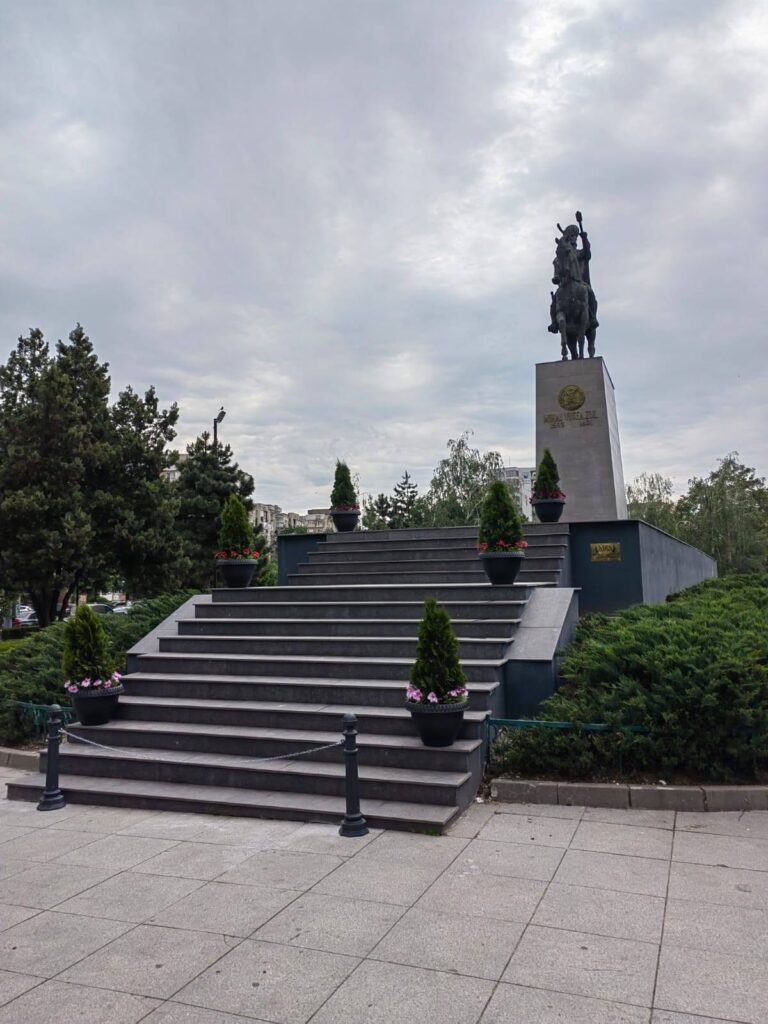
Equestrian Statue of Mihai Viteazul
Location: Mihai Viteazul Park.
The statue depicts the ruler on horseback, in a solemn pose. The monument was unveiled in ’97, marking 400 years since Ploiești was first documented as a princely fair-town, and symbolically links the city to the figure of its founder in local tradition.
It is one of the most photographed spots by tourists and, together with the axis of Bulevardul Republicii, makes up one of the city’s “postcard” images.
The pedestal was rebuilt at the start of 2025.
Statue of Liberty
Location: central area (Piața Libertății – today’s Piața Victoriei).
The Statue of Liberty stands in the central area (Piața Eroilor) and is an allegory of the goddess Minerva, a symbol of liberty and victory. The sculpture, made at the end of the 19th century in Paris and brought to Ploiești, is cast in bronze and placed on a stone pedestal decorated with bas-reliefs.
Erected after Romania gained its state Independence, the statue became a civic symbol of the city, tied to the idea of modernisation and the assertion of national identity.
Statue of Nichita Stănescu
Location: central area, in the park bearing his name
The bust dedicated to poet Nichita Stănescu marks one of the most important cultural landmarks of Ploiești. Cast in bronze and placed on a circular pedestal surrounded by flowers, the monument speaks to the city’s deep ties to the poet who was born here.
The bust was made by sculptor Ștefan Macovei and unveiled on 24 September 1999. Its central location turns it into a stop for poetry lovers, while the surrounding space is often used for commemorations, literary recitals and events dedicated to Nichita’s work.
The monument is part of the city’s cultural circuit, complemented by the “Nichita Stănescu” Memorial House, a few minutes’ walk away.
“Ion Luca Caragiale” Monumental Ensemble
Location: central area (next to the Palace of Culture)
The “Ion Luca Caragiale” Monumental Ensemble is dedicated to the most famous writer linked to Ploiești. The sculptural group depicts Caragiale seated on a bench, looking towards his characters from the short story “Domnul Goe”, caught in a humorous scene.
Unveiled in 2012, the ensemble stands in the city centre, close to the pedestrian route used by locals and visitors, and has become a favourite spot for photos and meetings on “Caragiale’s bench”.
Busts
Toma Caragiu Location: next to the “Toma Caragiu” Theatre, central area.
Toma T. Socolescu Location: in front of the Halele Centrale (Central Market Halls).
Mihai Eminescu Location: the esplanade next to the Ploiești Trade Unions’ House of Culture.
Ion Luca Caragiale – bust (high school) Location: the esplanade in front of the former “Sf. Petru și Pavel” High School (today the “Mihai Viteazul” National College), Bulevardul Independenței.
Ion Luca Caragiale – bust (memorial house) Location: courtyard of the “I.L. Caragiale” Memorial House, str. Kutuzov.
Paul Constantinescu Location: courtyard of the “Paul Constantinescu” Memorial Museum, str. Nicolae Bălcescu.
Nicolae Simache Location: courtyard of the “Nicolae Simache” Clock Museum.
Lazăr Edeleanu Location: courtyard of the “Lazăr Edeleanu” Technological College, southern part of the city.
Ilie Oană Location: at the main entrance of the “Ilie Oană” Stadium
I. A. Bassarabescu Location: courtyard of the “I. A. Bassarabescu” School, the western part of the city.
Anghel Saligny Location: in front of the CONPET S.A. headquarters.
Radu Stanian Location: a small square on the right side of Bulevardul Independenței, at the intersection with two side streets.
Virgil Madgearu Location: courtyard of the “Virgil Madgearu” Economic College, str. Rudului 24.
Take Ionescu Location: in front of the “Sfinții Împărați” Church.
I. G. Duca Location: the park in the civic centre, in front of the Unirea building.
Carol Nicolae Debie Location: courtyard of IPIP / Petroconsult (southern area, oil platform).
Alexandru Ioan Cuza Location: courtyard of the “Al. I. Cuza” National College.
Alexandru Ioan Cuza Location: Piața Eroilor, in front of the City Hall.
Constantin Dobrogeanu-Gherea Location: the park in front of the Halele Centrale.
Vlad Țepeș Location: courtyard of the Prahova County Museum of History and Archaeology.
Henry IV Location: Bulevardul Independenței, in front of the “Mihai Viteazul” National College.
Mircea cel Bătrân (Mircea the Elder) Location: courtyard of the Prahova County Museum of History and Archaeology.
Matei Basarab Location: courtyard of the “Sfinții Voievozi” Church.
Manage Consent
To provide the best experiences, we use technologies like cookies to store and/or access device information. Consenting to these technologies will allow us to process data such as browsing behaviour or unique IDs on this site. Not consenting or withdrawing consent, may adversely affect certain features and functions.
Functional
Always active
The technical storage or access is strictly necessary for the legitimate purpose of enabling the use of a specific service explicitly requested by the subscriber or user, or for the sole purpose of carrying out the transmission of a communication over an electronic communications network.
Preferences
The technical storage or access is necessary for the legitimate purpose of storing preferences that are not requested by the subscriber or user.
Statistics
The technical storage or access that is used exclusively for statistical purposes.The technical storage or access that is used exclusively for anonymous statistical purposes. Without a subpoena, voluntary compliance on the part of your Internet Service Provider, or additional records from a third party, information stored or retrieved for this purpose alone cannot usually be used to identify you.
Marketing
The technical storage or access is required to create user profiles to send advertising, or to track the user on a website or across several websites for similar marketing purposes.